
HORSES (PC): A Bluntly Buñuelian Attack on Authoritarianism
The context around HORSES means that all conversations about the game end up being conversations around the game, and about the state of the medium as a whole. Despite being one of the most talked about games of the moment, it has somehow fallen out of the conversation even about itself. For a brief explainer, a ban from Steam, followed by a ban from the Epic Store, is more of an illustration of a systemic problem with distribution than anything else. While any platform holder can obviously decide what to put and not to put on their respective platforms, each decision sends a message and creates a larger reflection on what they have decided to platform. The bigger problem is the system, where meaningful distribution is narrowed to too few places and your possibility of success is based on the whims of large corporations that are also deeply affected by the whims of payment processers (as we saw earlier this year, which this scenario is really a coda to).
What this has all done is frame every conversation around the game HORSES as a speculative search for extremity. To make an aside, there's a piece in Don LeLillo's novel, White Noise, about the most photographed barn in the country which concludes, among other things, that 'once you've seen the signs about the barn, it becomes impossible to see the barn.' The context placed around the barn becomes the story of the barn to the extent you can never see it without this context placed around it. You cannot just play HORSES anymore, you can only play HORSES: The Game Too Extreme for Steam and thus will only receive it in that way. A shame, really, as this alters the natural progression of the narrative and somewhat skews the messaging of the game. HORSES does want to shock you but it wants to shock you in a different way: it wants to shock you due to your complicity in cruelty and in line with larger messaging about authoritarianism. Now, the player is looking for shocks and evaluating the shocks against a metric of 'is this shocking enough?'.
This becomes even more apparent if you look at how the game describes itself in promotional materials. The potted description is purposefully vague:
'An enigmatic first person horror adventure that blurs the line between reality and the darkest corners of your imagination. Fourteen days, a horse farm, and a few rules to follow.'
And the longer description engages in an act of deception to describe the surface of the game rather than what is uncovered as you play. This, really, is how HORSES should be engaged with and, even in this review, we've strayed too far away. Ban be damned, HORSES is interesting because HORSES is interesting, a game worth playing entirely on its own terms.
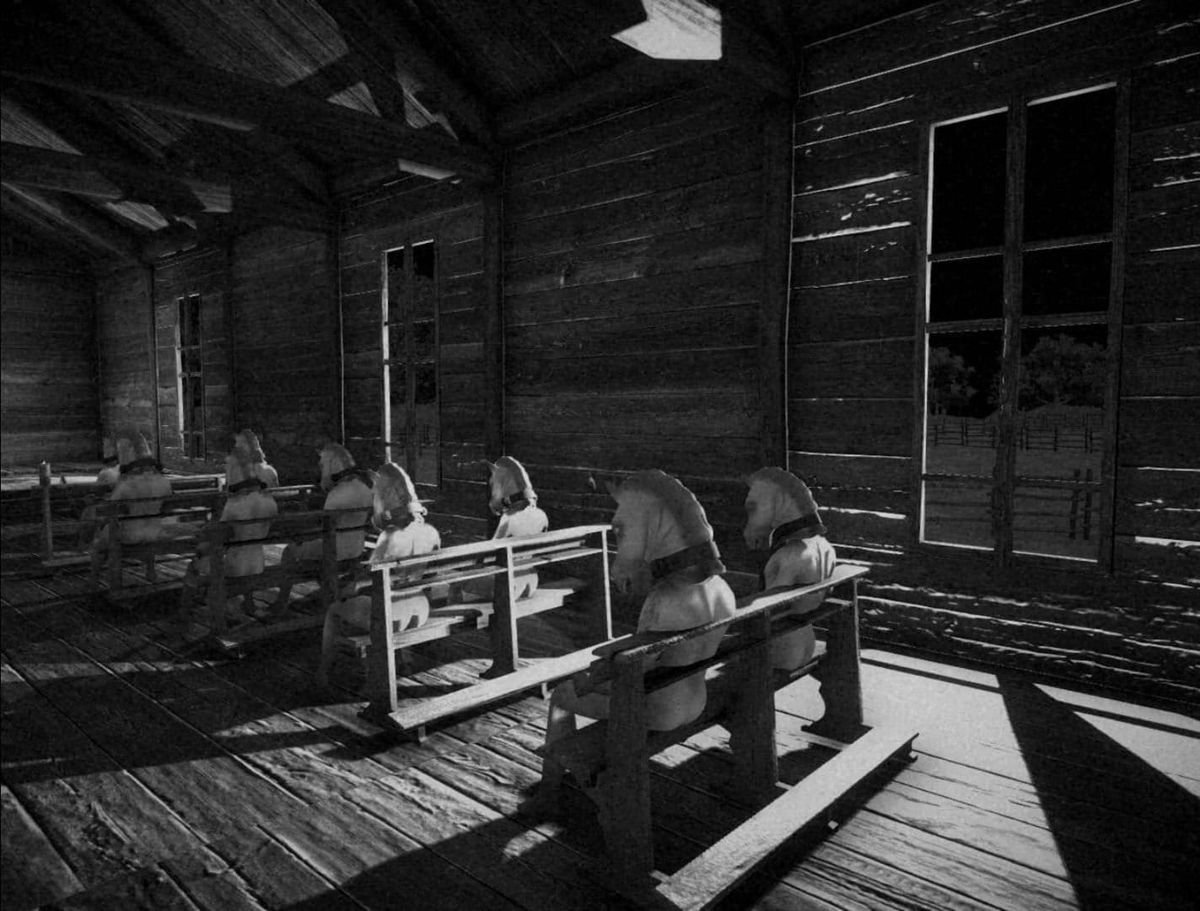
Something that is immediately appealing about HORSES is that its reference points place it outside of most other games. The game adopts a specifically filmic aesthetic, a black and white look complete with silent film codes such as intertitles. An obvious comparison point, and an overt inspiration, is the early work of Luis Buñuel. Later in the game, you watch a suspicious looking VHS tape that houses a short film deeply inspired by the syntax of Un Chien Andalou (1929), and the wider game could certainly be compared to L'Âge d'or (1930) and, most pertinently, Land Without Bread (1933). There's an overt engagement with polemical surrealism as well as an unflinching naturalism where stylistic flourishes are engaged to ultimately display humanity at its cruellest, in a way that should be read as a reflection of social systems. To go beyond Buñuel, while the wider gaming press has pointlessly postulated about 'gaming's Citizen Kane' for decades, we can at least now declare gaming's Salò, or the 120 Days of Sodom (1975). This is where HORSES sits, an Italian tale about hierarchical treatment that is deeply concerned with the horrors of fascistic dehumanisation. Genuinely anti-authoritarian art that is making progressive and interesting points through intentionally wielded extremity, and certainly not something we should be banning (to briefly indulge with a conversation best avoided because of the unwanted implications).
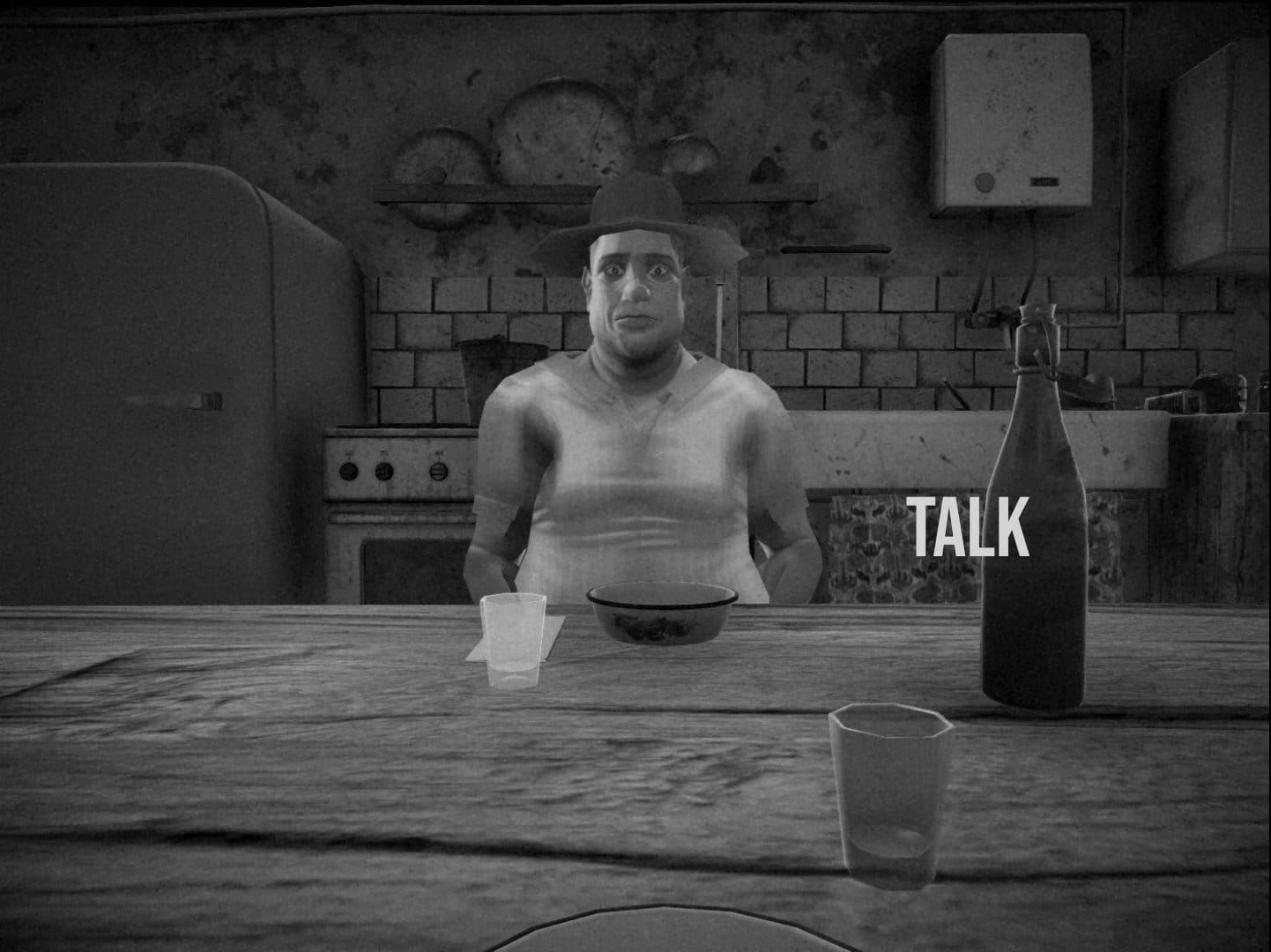
The game is carefully structured, a narrative game with light mechanics but that does make its points through interaction rather than filmic exposition. You, in first person, play a young adult who – after apparently wasting his time at college – has been sent to get some work experience on a farm. The connotations here are obvious in terms of expectations around masculinity and social conformity. The farm is run by a single owner, an older man, and you become his only member of staff. You are there for fourteen days (here the game finds its loop and rhythm) and, while you are there, you need to do the chores expected of you. This is how things start, a Papers, Please (2013) esque conceit where you are told to do things and you do those things because you are told to do them. There is no room for failure or divergence here, though. At points, you can react (usually positively or negatively) to something suggested to you but, no matter what you pick, you will have to go along with one forced path. You cannot opt out outside of quitting the game; HORSES wields autonomy as a way to make a point about lack of autonomy. It is not the illusion of choice, it is foregrounding the point that you have no choice and a way of making you complicit. The first major discovery is that this horse farm is not a horse farm. Instead of being for horses, it is actually populated by enslaved humans wearing horse masks, forced to live in captivity as animals. Your boss acts like they are just horses but, as you get a small assortment of visitors, it is clear that (even in fiction) this is not the case. You learn that a supposed flouting of societal norms has got them here and no more is filled in, this itself leading back into the point about lack of autonomy in rigid systems.
The game world is limited to the farm, with different parts of it open to you at different points. Days predominantly follow the same structure, a loop of Jeanne Dielman (1975) esque domesticity where repetition is wielded as a way to highlight deviation. Here, the prosaicness of your tasks is effectively juxtaposed with the cruel reality of what you are engaged in. Normal tasks on a farm become horrific when considering you are actually furthering enslavement, with no room for deviation. At points, you have to follow orders from your boss that involve disciplining and harming the enslaved people. This is inherently extreme but a few things you have to do are particularly extreme, and the game makes you do them. A light interactive layer adds force to the messaging that makes it even more bluntly effective than something like Salò. Rather than just confronting your voyeurism (and making you bear witness), this uses gameplay to make you complicit and to thus further the point of how fascistic systems work. To the game's credit, the overall narrative is an arc towards revenge and a kind of justice – if a twisted form of this which makes its own point about how broadly destructive these system are. While the game doesn't let you not conform, because it is also narratively on rails, it doesn't let you not rebel. This is a powerful utilisation of the inherent agency of video game mechanics that manages to embed the discomfort of cruel systems while also mechanically pushing the need for resistance.
This all being said, it is a stilted and at points poorly articulated experience. The objective focused nature can get in the way, where trying to work out exactly what the game wants you to do (or how to achieve that within rudimentary systems) creates meta-thinking as opposed to message-thinking. It is not the perfect blend of gameplay and narrative, and one could very much argue it overstates its point and does not always express it in the most effective ways. However, the overall success of the game is more a condemnation of how little the wider medium engages with these kind of semiotics to this extent. There are numerous immediate parallels to film and literature – I was specifically reminded of the poem Giuseppe, by Roderick Ford (available on his website, https://www.roderickford.com/giuseppe/). Yet another Italian located tale of the dehumanising effect of fascism, in that poem 'the only captive mermaid in the world / was butchered on the dry and dusty ground': a narrative about the same kind of animalisation that reflects how the other is treated under fascism and the masks we put on to ameliorate abject cruelty. It is an exceptional poem and is on the high school syllabus for English Literature in the UK. Salò and the works of Buñuel are canonised classics. One could also link HORSES to Yorgos Lanthimos' Dogtooth (2009), a filmmaker that now has very broad acclaim. HORSES is not on the same level as any of these works but that is not the point. Where other mediums see it as their duty to challenge and provoke for intellectual reasons, this impulse in gaming is still held with suspicion. The really depressing part is that wider art forms are not without similar scandals but the voices of dissent come from outside. When it comes to video game censorship, the call is coming from inside the house, a truly depressing place to be.




Comments ()